Vector and Matrix Intuition.
Wrong intuition means the first step is already wrong. Many people have the wrong intuition
about the equation y = W @ x.
They intuitively think that vector x and vector y are the same kind of thing — just
"vectors."
This intuition is wrong. It is as laughable as treating a cat and a dog as the same animal just because they are
both pets.
A vector has two defining features: direction and length. Therefore, if the
direction changes, it is a completely different vector — like two entirely different species.
We must intuitively realize that y = W @ x is exactly like turning a cat into a dog. Only with this
correct intuition can you truly begin your journey into machine learning and deep learning.
For most vectors x, after multiplying by W, the direction will change, as if a cat turned into a dog(🐱 → 🐶), but there
are always some special vectors that, after multiplying by W, keep the same direction and are only scaled in
length, as if a small cat turned into a big cat (🐱 → 🐱); in this case, x is an eigenvector.
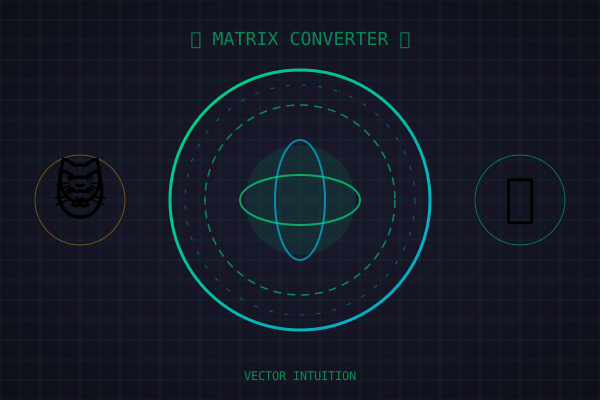
The Wrong Intuition
People think y = W @ x means x and y are the "same kind of thing."
Wrong. A vector has direction and length. Changing its direction changes its species — it's like turning a
cat into a dog.
That is the true intuition behind every matrix transformation.
Change of Basis
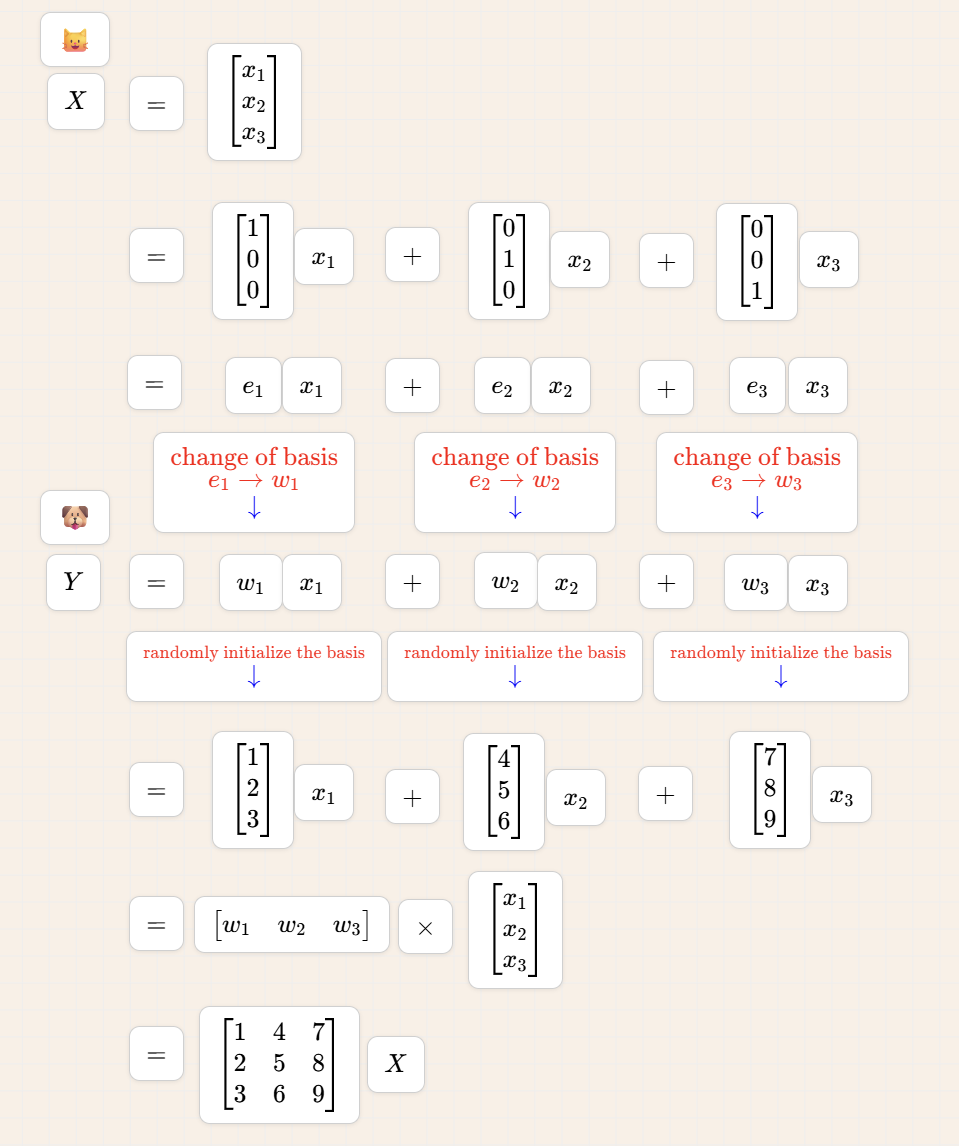
How exactly does a matrix turn a cat into a dog? The answer is a change of basis.
A vector is just a set of coordinates pointing to specific directions (basis vectors \(e_1, e_2, e_3\)). When we multiply by a matrix \(W\), we are essentially defining a new set of basis vectors (\(w_1, w_2, w_3\)).
The input \(X\) (the cat) is measured using the old basis. The output \(Y\) (the dog) is the exact same data, but measured using the new basis. The matrix doesn't just "crunch numbers" — it completely redefines the coordinate system.
Many people do not have an intuitive understanding of y = W @ x, and I believe that the process
of W @ x can be derived from the definition of x itself, as shown in the image on the right. For
more interesting content, please follow "Learn Linear Algebra in Three Days."
Linear Algebra
in 3 Days
Linear algebra often begins by piling up a large number of new symbols and definitions: vector spaces, linear independence, bases, dimension, rank, kernel... Beginners can often recite the definitions, yet have no idea what these concepts are really saying. Therefore, I believe that building geometric intuition alone is not enough for learning linear algebra; students also need to build an architectural intuition that traces things back to their roots. To this end, I propose a learning method based on extraction-based cognitive pruning and assimilation strategies, and guided by this idea, I wrote Learn Linear Algebra in Three Days.
Why I Wrote This Book
Learning linear algebra is a "nightmare" for many students in science and engineering, computer science, economics, and even the humanities who are transitioning into data science. The pain point often lies not in how difficult the calculations are, but in the discontinuity in ways of thinking and the piling up of abstract concepts.
Linear algebra often begins by piling up a large number of new symbols and definitions: vector spaces, linear
independence, bases, dimension, rank, kernel... Beginners can often recite the definitions, yet have no idea
what these concepts "are saying." The pain point in learning is that definitions can be repeated, but
intuition cannot be built, which leaves students with no choice but to memorize subsequent theorems by rote.
The biggest pain point in linear algebra is that the "symbols—geometry—applications" triad is not connected.
Students are forced to memorize and calculate at the purely symbolic level, with neither intuitive support nor
motivational drive, while also facing a high-density, strongly cumulative course pace. The key to alleviating
this usually lies in: building geometric intuition as early as possible (using 2D/3D visualization). It is
recommended to pair this with 3Blue1Brown's "Essence of Linear Algebra" video series; building geometric
intuition first is crucial.
However, I believe that building geometric intuition alone is not enough for learning linear algebra, because
linear algebra has too many concepts that define one another, forming cycles. Students also need to build an
architectural intuition that traces things back to their roots. To this end, I propose a learning method based
on extraction-based cognitive pruning and assimilation strategies, and guided by this idea, I wrote Learn
Linear Algebra in Three Days.
The Learning Method
This book isn't just a collection of formulas. It's built on a specific learning strategy:
Extraction-Based Cognitive Pruning and Assimilation.
Specifically, the approach is as follows: In the first step, firmly grasp a few key pieces of knowledge, discard
non-core knowledge, thoroughly master these key knowledge points, and then repeatedly review these few key
knowledge points in the mind. In the second step, when encountering other new knowledge, evaluate it: if it can be
associated with the key knowledge, then it is also classified as key knowledge in the mind; if it cannot be
associated, then it is discarded from consciousness. Ultimately, by retaining a few key knowledge points, the
entire subject of linear algebra is connected together.
Cognitive Pruning
This concept corresponds to the "discarding the non-core" part. It refers to the brain deliberately "erasing" concepts that are weakly generalized or unnecessary in order to reduce cognitive load, similar to "reading a book down to its essence." Your actively discarding knowledge that cannot be associated is precisely this pruning process.
Extraction
This concept corresponds to "repeatedly reviewing these key knowledge points in the mind." It refers to actively recalling information from memory rather than passively rereading it, and it is one of the most robust methods for strengthening memory.
Assimilation
This concept corresponds to the "classifying new knowledge as key knowledge" part. It refers to establishing substantive connections between new information and appropriate existing ideas in one's cognitive structure; if such connections cannot be established, the new knowledge is difficult to retain meaningfully. Your principle of keeping what can be associated and discarding what cannot is based precisely on whether assimilation can occur.
Who this book is for
✅ Read this if you
- Have a deadline and need linear algebra fast
- Studied it before but it's still fragmented
- Need the math for ML
- Got burned by textbooks
❌ Skip this if you
- Need rigorous proofs
- Want a full textbook
- Have zero math background
- Want a workbook
- Expect mastery in 3 days
Frequently Asked Questions
Does "3 days" mean I'll master linear algebra?
No. 3 days gets you a usable framework and the ability to read and use linear algebra without getting lost. Mastery comes from practice after that.
What's inside
Three days, twelve concepts. Each day ends with something you can run.
Vectors & Spaces
What a vector really is
Matrix Multiplication
Linear transformations in code
Transpose & Dot Product
Similarity and geometry
Norms & Distance
Measuring vectors
Eigenvalues & Eigenvectors
Stable directions
SVD
Low-rank magic
Matrix Decompositions
Why approximations work
Rank & Null Space
What a matrix can and cannot do
Jacobians
Derivatives as matrices
Covariance
How variables move together
Tensors
Beyond 2D
Putting It Together
Read a model's math end to end
Read a free chapter
Get Day 1 — “Vectors & Spaces” and see how the book teaches intuition without proofs.
Early readers
“No proofs. Just code and intuition. Exactly what I needed to stop feeling lost in papers.”
“The SVD day alone was worth the price. I had read about it three times before, but this made it click.”
“Three days, and I finally understand what a matrix does. I wish I had this before my first deep learning course.”
Linear Algebra in 3 Days
From zero to intuition — the matrix math you need for AI
- 📘 12 chapters, ~90 pages PDF
- 💻 40+ PyTorch code examples
- 📐 Visual intuition, no proofs
- 🔄 Free lifetime updates
- 📄 Bonus: one-page linear algebra cheat sheet
Reader comments
Short notes from readers. Comments appear after review. Your email is optional and will never be shown publicly.

No comments yet. Be the first.